

School and Team Buses: What Happens When Kids Get Hurt?
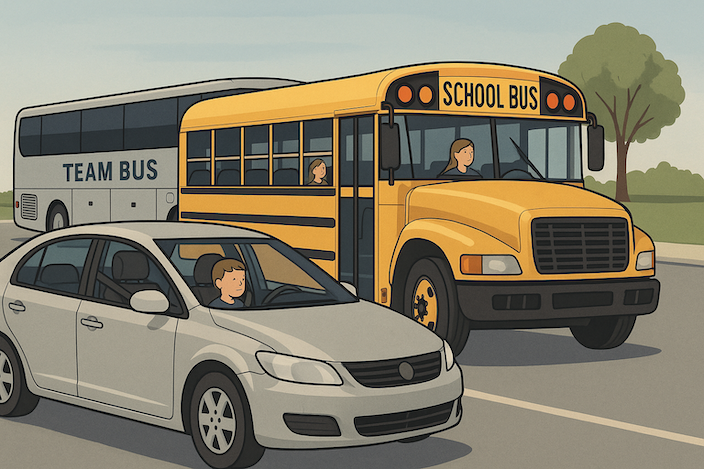
Every school day in Maine, kids climb into booster seats in family cars, line up at bus stops, and load onto team buses for away games. Most of those trips end uneventfully. But recent crashes in Maine and across the country show how fast a routine ride can turn into a life-changing injury for a child or student-athlete.
For families, the key questions after a crash are the same: Was this preventable? Who is responsible? And how do we protect our kids going forward? At Peter Thompson & Associates, we help parents answer those questions and pursue justice when a child gets hurt on the way to school or sports.
School Buses Are Very Safe—But Not Accident-Proof
Federal safety data still show that school buses are among the safest vehicles on the road. Less than one percent of all traffic fatalities involve children riding in school transportation vehicles. Strong structures, high seat backs, and “compartmentalization” (closely spaced, padded seats) help protect kids in many crashes.
But “safer than a car” does not mean “risk-free.” NHTSA has documented more than 100 occupant deaths in school transportation vehicles over a recent ten-year period, and fatalities in school-transportation-related crashes have been rising. Children also face dangers around buses—crossing streets, walking in front of or behind vehicles, and loading in chaotic traffic.
Maine has felt those risks close to home. In November 2025, an RSU 13 student in Rockland died after a school bus struck the child at an intersection; police called in crash reconstruction specialists, and the investigation is ongoing. In 2024, a bus in Minot left the road and went into a ditch, injuring multiple students, and state officials reported roughly two dozen school bus crashes in a single year, more than half considered preventable.
Team Bus Crashes Put Student-Athletes in the Spotlight
Across the country, recent team-bus incidents have reraised the question: Are we really doing enough to protect kids once they’re on the bus?
- In Oklahoma, a high school softball team’s bus hit a deer and rolled over, injuring seven people; investigators reported that the driver’s seat was the only one equipped with a seat belt, and some students were thrown from the bus.
- In Iowa, members of the Remsen St. Mary’s girls’ basketball team suffered serious injuries when their small team bus collided with a Jeep at a highway intersection; one teenager was airlifted from the scene, and others were transported to trauma centers.
- In Texas, more than 40 elementary students were on a bus that rolled over on the first day of school; the bus did have lap-shoulder belts and five-point harnesses, but video showed only six children were belted, and only two were wearing the belts correctly. The National Transportation Safety Board (NTSB) issued an urgent call for stricter seat-belt policies and enforcement.
These crashes highlight three hard truths:
- Seat belts matter. They dramatically reduce the risk of serious injury in rollovers and ejections.
- Many kids still ride without belts. On some buses, belts don’t exist; on others, kids simply don’t use them.
- Policy and enforcement are just as important as hardware. A bus full of unused seat belts doesn’t protect anyone.
The Seat-Belt Debate: Compartmentalization vs. Belts
For years, regulators have relied on “compartmentalization” to protect children in large school buses: strong, closely spaced, energy-absorbing seats that create a padded “cocoon” without requiring kids to buckle up. That approach works reasonably well in many frontal crashes.
But it has clear limits:
- It doesn’t keep a child in place during a rollover or a side impact.
- It doesn’t prevent kids from sliding out of position, standing up, or being thrown into aisles.
- It offers little protection when children aren’t seated properly—exactly what investigators have found in real crashes.
After a deadly Tennessee crash involving a school bus and a utility truck, the NTSB concluded that properly worn lap-shoulder belts would have reduced injuries, and it renewed its recommendation that states require these belts on all new large school buses.
In other words, national safety experts increasingly agree: compartmentalization alone isn’t enough—especially when buses leave the relatively low-speed world of neighborhood routes and head onto highways for games and field trips.
Maine’s Booster Seat Laws: Protecting Kids in Cars and Vans
Not every trip to school or practice happens on a full-size yellow bus. Parents, coaches, and volunteers often drive kids in cars, SUVs, and 12- or 15-passenger vans. In these vehicles, Maine’s child passenger safety laws clearly apply.
Under Maine law and state safety guidance, drivers must:
- Keep children in a rear-facing seat until age 2 when possible.
- Use a 5-point harness up to 55 pounds.
- Keep kids who are under 8 years old, under 80 pounds, and under about 4′9″ in a belt-positioning booster seat.
If a coach or parent driver ignores these rules and a child suffers serious injuries in a crash, that violation can become important evidence of negligence in a personal injury case.
Who May Be Liable When a Maine Child Is Hurt in Transit?
When a child or student-athlete is injured on the way to school or a game, multiple parties may share responsibility:
- School districts or private schools – for hiring unqualified drivers, failing to maintain buses, ignoring known safety issues, or violating their own transportation policies.
- Bus companies and charter operators – for negligent maintenance, inadequate driver training, or using older buses without basic safety upgrades.
- Other drivers – for speeding, distracted driving, impaired driving, or failing to stop for school buses with flashing red lights.
- Equipment and vehicle manufacturers – if a defect in the bus, seat, seat belt, tire, or steering system contributes to the crash.
- Coaches or volunteers driving personal vehicles – if they overload cars, ignore booster-seat laws, text behind the wheel, or drive when overtired.
In many cases, more than one party bears fault. A thorough investigation—often including crash reconstruction, maintenance records, on-board video, and school transportation policies—is critical.
What Maine Parents Should Do After a Bus or Team-Travel Injury
If your child is hurt in a crash involving a bus, van, or car on the way to school or an activity, you can take several steps to protect both their health and their legal rights:
- Get immediate medical care. Even if injuries seem minor at first, head trauma, internal injuries, and psychological harm can emerge over time.
- Collect information. Names and contact details for the driver, school officials, witnesses, and other parents are important.
- Preserve photos and video. Pictures of the scene, the vehicles, the seating layout, and visible injuries can become vital evidence.
- Request key documents. Transportation policies, incident reports, and any notice sent to parents can all matter later.
- Avoid signing anything from an insurance company or school district before you understand your rights.
An experienced Maine child-injury attorney can move quickly to secure on-board camera footage, electronic data, maintenance records, and any prior complaints or safety reports involving the bus or driver.
How Peter Thompson & Associates Helps Injured Kids and Families
At Peter Thompson & Associates, we represent children and families across Maine after:
- School-bus crashes
- Team-bus and charter-bus wrecks
- Car and van crashes involving booster seats and child restraints
- Pedestrian incidents involving buses and school traffic
Our team works to:
- Investigate what really happened and whether the crash was preventable
- Identify all responsible parties and insurance policies
- Work with medical experts to understand a child’s long-term needs
- Seek compensation for medical bills, future care, lost opportunities (sports, scholarships), pain and suffering, and emotional trauma
We know that no settlement can undo a frightening crash or serious injury. But holding negligent drivers, school systems, and companies accountable can provide families with the resources they need—and can push institutions to adopt better policies and safer buses for every child in Maine.
Your Child Was Hurt on the Way to School or a Game? Talk to Us.
If your child or a student-athlete in your family was injured in a bus, van, or car crash on the way to school, practice, or a game, you don’t have to navigate this alone.
Contact Peter Thompson & Associates for a free consultation. We’ll review what happened, explain your options under Maine law, and fight to protect your child’s future.