
Roundabout Accidents in Maine: Who Had the Right of Way?
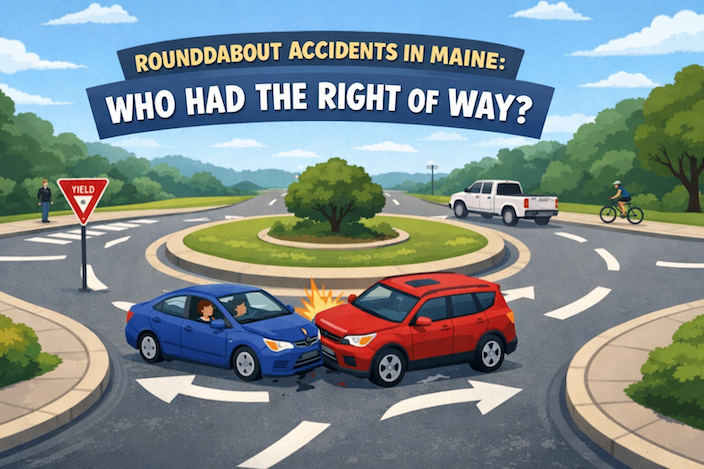
Roundabouts (also called traffic circles or rotaries) keep traffic moving, but they also create a predictable set of “failure-to-yield” crashes—especially when drivers panic, change lanes mid-circle, or treat the roundabout like a four-way stop. If you’ve ever driven through a busy Maine roundabout during tourist season or winter weather, you’ve seen the confusion: someone stops inside the circle, someone tries to “shoot the gap,” and someone else swings wide like they’re towing a trailer (even when they aren’t).
When a crash happens, the first question usually sounds simple: Who had the right of way? In Maine, the answer comes from a mix of (1) Maine’s right-of-way statute, (2) crosswalk rules, and (3) the roadway markings and signs that control each specific roundabout.
Below is a practical, Maine-specific guide to how right of way works—and how people get it wrong.
The core Maine rule: yield to vehicles already in the roundabout
Maine law states it plainly: a driver approaching a traffic circle/roundabout/rotary must yield the right of way to a vehicle already inside the circle, unless an officer or traffic-control device says otherwise.
The Maine BMV’s motorist handbook teaches the same rule in everyday language: “When entering a traffic circle, the vehicle which is already in the circle has the right-of-way.”
What that means in real life:
If you enter and hit a car already circulating, you will often start the case on the defensive. Insurers and police reports commonly treat that as a classic “failure to yield” scenario.
“Yield to the left” inside the circle
Maine law also includes a second roundabout-specific instruction: drivers must travel to the right of the center island and yield the right of way to a vehicle on the operator’s left while entering, circulating, and exiting.
This rule matters most when drivers operate side-by-side in multi-lane roundabouts or when someone drifts left/right within the circle. The left-side reference fits the counterclockwise flow: vehicles appear on your left as they circulate.
Common mistake: a driver enters, immediately drifts left (or swings wide), and clips a vehicle already beside them.
Roundabouts still require drivers to yield to pedestrians
A lot of roundabouts in Maine place crosswalks near the entries/exits. Those crossings create a second right-of-way layer: pedestrians.
Under Maine law, when traffic-control devices aren’t operating, a driver must yield to a pedestrian who is crossing within a marked crosswalk—or who shows visible intent to enter it.
Practical takeaway:
A driver can have the right of way against another vehicle but still must yield to a pedestrian in the crosswalk. A “vehicle vs. vehicle” dispute doesn’t erase crosswalk duties.
The most common Maine roundabout crash scenarios (and who usually has the right of way)
1) Entering driver hits circulating driver
Typical right-of-way result: Circulating driver has it.
How it happens: The entering driver looks right instead of left, misjudges speed, or assumes the other car “should stop.”
2) Rear-end crash inside the roundabout
Typical right-of-way result: The rear driver usually bears responsibility for following too closely and failing to maintain control.
How it happens: Someone stops unexpectedly in the circle (often due to confusion), or traffic backs up at a downstream exit.
MaineDOT’s own guidance warns drivers not to stop in the circulating roadway and to yield only at the entry. Maine
3) Sideswipe from a lane change inside a multi-lane roundabout
Typical right-of-way result: The driver who changes lanes (or drifts out of lane) often takes the blame—especially if pavement markings show each lane’s allowed exits.
How it happens: A driver enters in the wrong lane, then “corrects” mid-circle.
4) Exit-angle collision: driver cuts across to take an exit
Typical right-of-way result: The cutting driver often causes the crash.
How it happens: The driver realizes they’ll miss the exit and darts across the outer lane.
MaineDOT advises drivers to choose the correct lane before entering and to stay in lane as markings guide them to the exit. Maine
5) Vehicle hits a pedestrian at a roundabout crosswalk
Typical right-of-way result: The driver often violates crosswalk-yield rules, depending on signals/markings and the pedestrian’s location/behavior.
How it happens: The driver stares left for a traffic gap and forgets to scan the crosswalk ahead.
“But I had the right of way” doesn’t automatically win the case
Right of way helps, but crash liability still depends on what each driver actually did: speed, lane position, signaling, distraction, visibility, and whether someone made an unsafe decision in the moment.
Maine’s comparative negligence rule can also reduce (or eliminate) recovery if both drivers share blame. A jury can reduce damages based on a claimant’s share of responsibility, and Maine bars recovery if the claimant is found equally at fault.
Translation: even if the other driver failed to yield, an insurer may still argue you contributed by speeding, failing to keep a proper lookout, or changing lanes improperly.
What evidence decides fault in a roundabout accident?
Roundabout cases often turn on details that don’t show up in a quick phone photo. Here’s what can matter:
- Dashcam footage (yours or a nearby vehicle’s)
- Traffic camera or business surveillance video near the intersection
- Skid marks / yaw marks showing braking or turning paths
- Damage location patterns (front-corner vs. side-impact)
- Lane arrows, yield lines, and signage (they can differ by roundabout)
- Witness statements from drivers behind you or pedestrians at the splitter island
- 911/dispatch timing and any admissions at the scene (“I didn’t see you”)
If you’re physically able after a crash, photograph the yield signs, lane arrows, and crosswalk placement—not just the vehicles.
What to do after a Maine roundabout crash
- Call 911 if anyone feels pain, dizziness, numbness, or confusion.
- Get medical care the same day if you can—head/neck injuries often worsen later.
- Photograph the roadway controls (yield lines, lane arrows, crosswalks, signs).
- Ask witnesses for contact info before they leave.
- Don’t argue right of way at the scene. Give a clear factual statement and let the investigation work.
- Notify your insurer promptly—but be careful with recorded statements before you understand the full injury picture.
- Contact a lawyer right away
How Peter Thompson & Associates Can Help
Roundabouts reduce certain types of high-speed collisions, but they still generate serious injuries when drivers fail to yield, drift across lanes, or overlook pedestrians at the crosswalk. If you were hurt in a Maine roundabout accident and the insurance company is disputing fault—or trying to minimize your injuries—you don’t have to handle it alone.
Peter Thompson & Associates helps injured Mainers investigate what happened, preserve evidence (including camera footage and witness statements), and pursue full compensation for medical bills, lost income, and pain and suffering. If you have questions about who had the right of way and what your claim may be worth, contact Peter Thompson & Associates to schedule a free consultation.