

Crosswalk Tragedies: When a Helpful Driver Causes a Crash
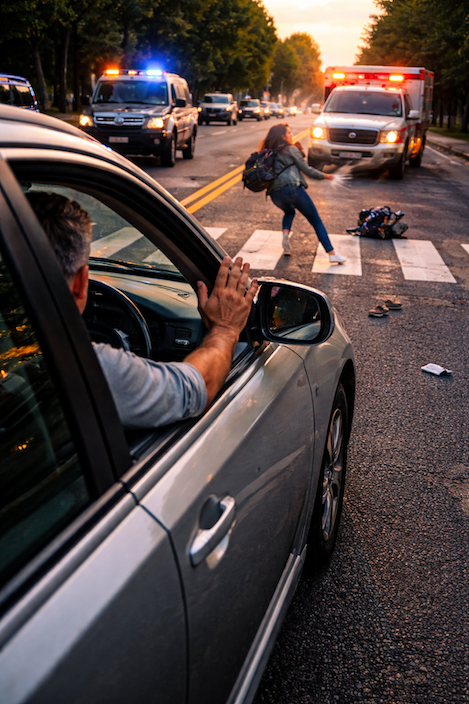
Drivers often try to be polite at crosswalks. A motorist stops, smiles, and waves a pedestrian across. The gesture looks kind—until it turns into a “multiple threat” crash.
In a multiple-lane roadway, one stopped vehicle can block sight lines for drivers in the next lane. The pedestrian steps out, trusting the “all clear,” and a second driver—who never saw the pedestrian—strikes them at speed. Safety researchers describe this exact scenario as a “MULTIPLE THREAT” crash: a pedestrian crosses in front of stopped/slowing traffic and gets hit by a second vehicle approaching in another lane in the same direction.
These crashes are among the most devastating pedestrian collisions because they happen quickly, involve higher impact speeds, and often produce severe brain, spine, and orthopedic injuries.
Below is how these tragedies happen, what Maine law says about crosswalk duties, and how liability often gets assigned when “courtesy” turns catastrophic.
Why the “wave-through” is so dangerous on multi-lane roads
A wave-through crash usually involves four ingredients:
- A marked crosswalk on a multi-lane road (two lanes in the same direction, or a center turn lane plus travel lanes).
- A “courteous” driver stops in the nearest lane and waves the pedestrian forward.
- The stopped vehicle blocks visibility for the pedestrian and the adjacent-lane driver.
- A second vehicle continues through the next lane and hits the pedestrian.
Researchers illustrate the mechanics plainly: the first car stops to let the pedestrian cross while blocking sight lines, the second car doesn’t stop, and the second car hits the pedestrian at high speed.
The MaineDOT crosswalk guidance focuses heavily on sight lines and visibility controls. For example, it requires “no parking” near crosswalks to prevent vehicles from hiding pedestrians and to improve visibility. That same visibility problem is exactly what a wave-through driver creates when they stop in the lane and act like a moving visual barrier.
What Maine law requires at marked crosswalks
Drivers must yield to pedestrians in marked crosswalks (and to visible intent)
Under Maine law, when traffic-control devices are not operating, a driver must yield the right of way to a pedestrian crossing within a marked crosswalk or who has shown visible intent to enter it.
That “visible intent” language matters. A pedestrian does not need to be fully in the lane before a driver’s duty begins.
Drivers may not pass a vehicle stopped for a pedestrian
Maine law also tackles the multiple-threat problem directly: when a vehicle stops at an intersection or marked crosswalk to permit a pedestrian to cross, a driver approaching from the rear may not overtake and pass the stopped vehicle.
That rule exists because passing the stopped vehicle is exactly how “wave-through” tragedies happen.
Who may be liable in a wave-through pedestrian crash?
These cases rarely involve only one careless person. Multiple parties can share fault.
1) The striking driver (often the primary defendant)
The driver who hits the pedestrian may bear substantial responsibility if they:
- failed to yield at a marked crosswalk,
- passed or tried to pass a vehicle stopped for a pedestrian,
- drove too fast for conditions, followed too closely, or drove distracted.
Even if that driver says, “I never saw them,” the law often expects drivers to anticipate crosswalk activity—especially when traffic patterns suggest someone stopped for a reason.
2) The “helpful” waving driver (sometimes)
The waving driver usually doesn’t strike the pedestrian, but the waving driver can still create risk by:
- signaling “it’s safe” when they cannot see the adjacent lane,
- encouraging the pedestrian to step into a lane the driver doesn’t control,
- stopping in a way that blocks sight lines and contributes to the multiple-threat setup.
Whether that becomes legal liability depends on the exact facts: what the driver signaled, whether the pedestrian relied on it, and whether the wave-through contributed to the pedestrian’s decision to enter the roadway.
3) The pedestrian (comparative negligence arguments)
Insurance companies often argue that the pedestrian should have confirmed the adjacent lane was clear before entering it. Maine follows a modified comparative negligence rule that reduces damages based on a claimant’s share of fault—and bars recovery if the claimant is found equally at fault.
That doesn’t mean a pedestrian “caused” the crash. It means the defense will try to divide responsibility, and the evidence will decide what share (if any) the pedestrian bears.
4) Road design and crosswalk placement (in limited situations)
Some wave-through collisions occur at crosswalks with poor sight lines, missing signage, or confusing layouts. MaineDOT’s crosswalk guidance emphasizes uniform placement, markings, and visibility measures.
However, claims against governmental entities involve special rules and defenses. A lawyer needs to evaluate those issues early.
Evidence that proves what really happened
Wave-through crashes create conflicting stories. Strong cases are built on objective proof, including:
- Scene photos/video showing lane count, crosswalk markings, sight lines, and where each vehicle stopped
- Surveillance footage (nearby businesses, municipal cameras, school cameras)
- Dashcam video from other vehicles
- Witness statements (especially drivers behind the stopped vehicle and pedestrians nearby)
- Crash reconstruction (impact point, pedestrian path, braking distance)
- Vehicle data (speed changes, braking, steering inputs)
- 911 call timing and police diagrams that show whether a vehicle stopped at the crosswalk
Because video often overwrites quickly, preservation letters and rapid requests can make the difference.
How to avoid a wave-through tragedy
For drivers:
- Yield when the law requires it—and do not pass stopped vehicles at a crosswalk.
- Don’t “direct traffic” with a wave. If you stop, stop because you must—then let the pedestrian decide when it’s safe to proceed.
For pedestrians:
- Treat a wave as “I’m yielding,” not “the road is safe.”
- Confirm each lane is clear before entering it, and make eye contact with drivers when possible.
Talk with Peter Thompson & Associates
A wave-through crash can leave a pedestrian with life-changing injuries in a moment—and it can trigger complex liability disputes involving the striking driver, the yielding/waving driver, and comparative negligence arguments. Maine’s crosswalk laws and “no passing a stopped vehicle” rule exist to prevent these exact tragedies.
If you or a loved one was injured in a crosswalk collision in Maine—especially on a multi-lane road—contact Peter Thompson & Associates to discuss what happened, preserve critical evidence, and pursue the compensation you deserve.