

Car Seat Recall Lawsuit: Evidence Parents Must Keep
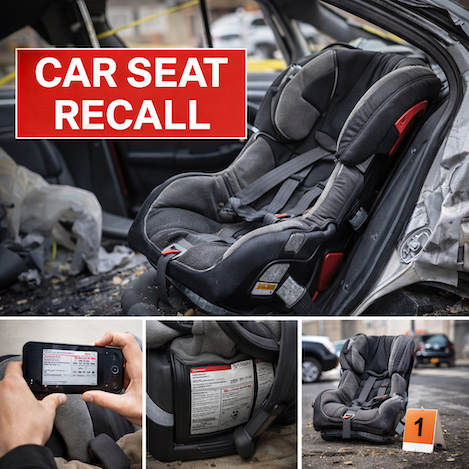
Car-seat recalls land in parents’ inboxes at the worst possible time—often right after a crash, when families feel shaken, exhausted, and eager to “clean everything up” and move on. In that moment, the child’s safety comes first. But parents also need to protect evidence if the crash injured a child and the car seat may have failed or worsened the harm.
That evidence disappears faster than most people realize. Insurers haul vehicles away. Tow yards strip interiors. Well-meaning family members toss a damaged seat into a dumpster. Labels peel off. Fluids dry. Photos never happen. When a recall later surfaces—or when parents discover that a seat already sat on a recall list—those missing details can make or break a car seat recall lawsuit.
Recalls also create confusion. A recall can signal a real safety issue. It can also address a risk unrelated to crash protection. For example, Evenflo has published voluntary recalls that involve very different issues—one describing a potential choking hazard that it states does not affect crash safety integrity, and another describing a potential rear-facing recline shift that could affect safety performance in a crash.
Parents in Maine can take simple, practical steps after a crash to protect their child and preserve the proof that matters.
Step one: keep your child safe and keep the seat
After any crash, prioritize medical care and safety. Then treat the car seat like physical evidence.
Do not throw it away. Do not give it to an adjuster. Do not “let the tow yard deal with it.” A product-liability claim often turns on the actual seat, not on later descriptions of what it “looked like.”
NHTSA recommends replacing a car seat after a moderate or severe crash, and it explains that a crash counts as “minor” only when all of these facts apply: the vehicle drove away, the door nearest the seat did not sustain damage, nobody suffered injuries, airbags did not deploy (if equipped), and the seat shows no visible damage.
That guidance points to a practical approach:
- If the crash looks moderate or severe, stop using the seat immediately and replace it for safety.
- Preserve the old seat anyway. Preservation supports the claim; continued use does not.
The evidence checklist that strengthens a car seat recall lawsuit
Parents rarely plan to document evidence during a crisis. A simple checklist helps.
1) Photograph the seat before you move anything
Use your phone and take more photos than you think you need:
- The seat in the vehicle from multiple angles (wide shots and close-ups)
- The belt path and/or lower anchors
- The tether (if used)
- Harness routing, chest clip position, and buckle condition
- Any visible cracks, stress marks, bent metal, loosened padding, or broken adjusters
- The vehicle door nearest the seat and any intrusion into the seating area
- Airbag deployment and interior damage near the seat
These images help experts evaluate installation, crash forces, and failure points.
2) Capture the serial label and identifiers
A recall lives and dies on identifiers. Before labels rub off or tear:
- Photograph the white serial/model label (often on the back or bottom of the shell)
- Photograph the manufacturing date, model number, and any QR codes
- Photograph the manual (if you still have it) and any registration card
Evenflo’s recall pages direct families to check model numbers and manufacture dates on labels when determining whether a seat falls within a recall population.
3) Preserve the seat exactly as it existed after the crash
Preservation does not mean “clean it up.”
- Do not wash the cover or straps.
- Do not disassemble or “test” components.
- Do not cut belts or straps.
- Do not store it outdoors.
Place the entire seat in a clean contractor bag or box, store it in a dry indoor space, and keep any loose parts together.
4) Lock down the crash details
Write down details while the memory stays fresh:
- Date, time, location, weather, and lighting
- Speed estimates and direction of impact
- Whether the vehicle required towing
- Airbag deployment
- Where the seat sat in the vehicle
- The child’s approximate height/weight and clothing bulk (winter coats matter)
- Any complaints the child made immediately after the crash
Pull the police report number and request the report as soon as it becomes available.
5) Preserve the vehicle evidence when you can
A seat does not exist in a vacuum. If the vehicle goes to a tow yard, take photos at the yard before repairs or salvage.
Ask the insurer or tow yard where the vehicle will go, and document:
- Crush/intrusion patterns near the seating position
- Seat belt condition in that seating position
- Damage to the vehicle seat and anchoring points
What a recall changes—and what it doesn’t prove by itself
A recall can help your case, but it does not automatically “win” it.
What a recall can do
- It can identify a known issue, affected model ranges, and potential remedies.
- It can support a timeline of knowledge and corrective action.
- It can point your attorney toward related complaints, testing, and communications.
Parents can track recalls through National Highway Traffic Safety Administration resources, including the NHTSA recall search tools and equipment recall information. NHTSA also encourages parents to register seats with manufacturers and notes that consumers can use NHTSA alerts (including the SaferCar App) to receive recall notices about car seats and booster seats.
What a recall does not prove
- It does not prove the recalled condition caused your child’s injury.
- It does not prove the seat failed in your specific crash.
- It does not prove correct installation or correct harness use.
- It does not replace expert analysis of defect and causation.
Evenflo’s Revolve360 Slim recall page, for instance, describes a choking-hazard concern and states that the issue “does not affect the safety or integrity of the car seat in the event of a crash.” That type of recall can matter for safety and for product history, but it may not explain crash injuries. By contrast, Evenflo’s All4One recall page discusses a rear-facing recline shift that it says could adversely affect safety performance in a crash. These differences show why families should avoid assumptions and preserve evidence for a proper investigation.
How NHTSA investigations intersect with civil claims
NHTSA oversees vehicle and motor-vehicle equipment safety recalls and related obligations, including recalls tied to safety-related defects. Regulatory action can generate documents and data that become important in a civil product-liability case. But civil claims still require proof tailored to the individual crash—especially proof of defect, causation, and damages. That proof often starts with the seat you preserved and the photos you took before anyone “cleaned up the mess.”
Talk to Peter Thompson & Associates after a crash involving a recalled car seat
Parents should not have to become investigators while caring for an injured child. But quick preservation steps protect options. If your child suffered injuries in a Maine crash and you suspect a car seat defect—or you later learn about a recall—act early. Save the seat, document the identifiers, and secure the crash details.
Peter Thompson & Associates can evaluate whether the facts support a car seat recall lawsuit, coordinate product-preservation steps, and work with the right experts to determine what the recall means—and what it doesn’t.
This article provides general information and does not constitute legal advice.