

Maine “Move Over” Crashes: Liability In Roadside Accidents
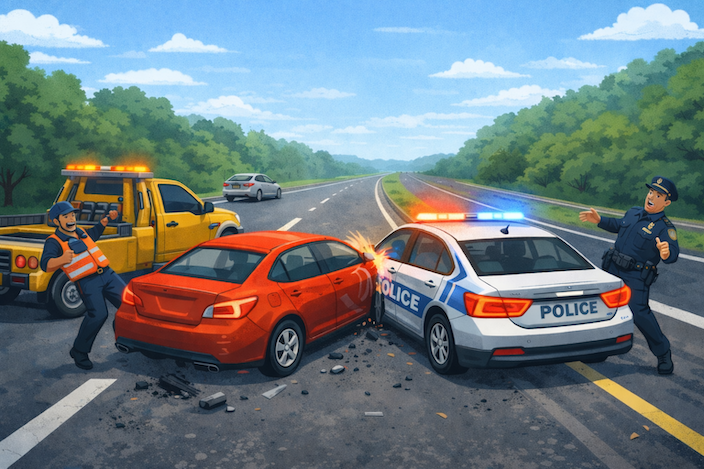
A routine roadside stop can turn catastrophic in seconds. A police cruiser pulls someone over on I-95. A tow operator hooks a disabled vehicle on Route 1. A family changes a tire on I-295 with hazards blinking. Then a passing driver drifts right—because of distraction, fatigue, impairment, or speed—and the impact triggers a chain reaction. These “move over” crashes often cause severe injuries because people stand inches from live traffic, and because secondary collisions can pile on before anyone can react.
In Maine, the law expects drivers to adjust when they approach roadside hazards. When drivers ignore that duty, they can create liability for themselves—and sometimes for employers, vehicle owners, or other parties whose choices contributed to the danger.
What Maine’s “Move Over” rules require
Maine law doesn’t treat a shoulder scene like “business as usual.” It requires you to give stationary roadside vehicles space when conditions demand it.
1) Passing emergency vehicles and public service vehicles with lights activated.
If you pass a stationary authorized emergency vehicle using emergency lights (think police, fire, EMS) or a stationary public service vehicle using its authorized lights (often includes tow/service vehicles and similar roadside assistance), you must either:
- move into a lane not adjacent to the stopped vehicle if possible, or
- if you can’t safely change lanes, pass at a careful and prudent speed reasonable for passing safely.
A violation triggers a traffic infraction with a minimum fine of $275.
2) Passing a “disabled-looking” stationary vehicle or one using flashing lights.
Since late 2023, Maine also requires extra care around ordinary disabled vehicles. If you pass a stationary vehicle that a reasonable person would conclude is disabled—or a vehicle using flashing lights to warn of its presence—you must:
- pass in a non-adjacent lane if possible, or
- if that is unsafe or impossible, pass at a careful and prudent speed reasonable for passing safely.
The Maine Turnpike Authority summarizes the 2023 expansion plainly: starting October 25, 2023, the move-over expectation “includes any disabled vehicle.”
3) “Emergency zones” require careful, prudent driving.
Maine law separately defines an “emergency zone” as a portion of roadway where emergency vehicles sit with lights activated for a response that presents risk, and it requires drivers to operate at a careful and prudent speed when approaching or passing through.
How a roadside stop becomes a violent crash
Move-over crashes don’t happen only because someone “didn’t feel like changing lanes.” They happen because drivers fail to account for a high-risk environment:
- Distracted driving: phones, GPS, in-car screens, or rubbernecking
- Fatigue or impairment: slower reaction times and lane drift
- Speed mismatch: highway speeds leave no margin for a sudden obstacle or a person stepping back
- Poor visibility: darkness, glare, rain, snow squalls, and fog
- Tight shoulders / narrow lanes: common on sections of Maine highways and rural routes
- Secondary collisions: a first impact blocks lanes, and following drivers collide before they can brake
In many cases, people outside vehicles—tow operators, police officers, passengers, or stranded drivers—suffer the most serious harm. National roadside-strike numbers underscore the danger, and the Maine Turnpike Authority specifically warns that emergency responders and people outside disabled vehicles get struck and killed every year.
Who may be liable after a Maine “Move Over” crash
Liability often turns on a straightforward question: Did the at-fault driver take reasonable steps to avoid creating a roadside strike? Maine’s move-over and passing-stationary-vehicle rules give a clear framework for that analysis.
Here are the parties that commonly appear in these claims:
1) The passing driver who struck the scene
Most cases start here. Drivers can create liability by:
- failing to move over when it was possible,
- failing to slow to a careful and prudent speed when they could not move over,
- driving distracted, impaired, or too fast for conditions,
- following too closely and causing a secondary collision.
When a driver violates a safety statute designed to protect roadside workers and stranded motorists, that violation can strongly support a negligence claim (and, in many cases, becomes the centerpiece of fault allocation).
2) The driver’s employer (commercial vehicles, delivery fleets, contractors)
If the striking driver drove for work at the time—delivery vans, service trucks, contractors, rideshare drivers—an employer may share responsibility under basic agency principles. These cases often expand into questions like:
- Did the company push unsafe schedules?
- Did it fail to train drivers on move-over rules?
- Did it ignore known safety problems?
3) Other drivers who caused the “secondary” impact
Some crashes begin with a near-miss or a sudden, unsafe lane change by a third driver. Others involve a rear-end collision because a following driver refused to slow in an emergency zone. Maine’s emergency-zone standard and general “careful and prudent speed” rule can matter a lot in these fact patterns.
4) Government entities and special notice rules
If a crash involves a state or municipal vehicle (or certain actions during a roadside stop), claims can raise governmental-immunity issues and strict notice requirements. Because deadlines and immunities can derail otherwise strong claims, you should treat any “government involvement” case as time-sensitive.
5) Comparative fault questions
Insurance companies often argue that the person on the shoulder contributed to the danger (standing too close to traffic, failing to use flashers, exiting on the traffic side, etc.). Maine uses comparative negligence principles, which can reduce damages based on the claimant’s share of responsibility. The facts—and the evidence you preserve early—often decide how much weight those arguments carry.
Evidence that can make or break a move-over case
These crashes happen fast, and the evidence disappears faster. Strong cases often hinge on:
- Dashcam / cruiser video / bodycam (police stops frequently generate video)
- Tow or service-truck logs and dispatch records (arrival time, location, lighting used)
- 911 calls and CAD (computer-aided dispatch) timestamps
- Vehicle “black box” / EDR data (speed, braking, throttle)
- Cell-phone records (when distraction becomes the central issue)
- Scene photos (lane positions, skid marks, debris field, lighting, sightlines)
- Witness statements from motorists who saw whether the striking driver moved over or slowed
If you can do so safely, photographing the scene and noting the exact mile marker or nearby landmarks can help your legal team reconstruct the crash and preserve the right evidence.
What to do after a roadside strike in Maine
Your first priority is safety and medical care. After that, the steps below can protect your claim:
- Get medical evaluation immediately (some serious injuries—head trauma, internal injuries—don’t show full symptoms right away).
- Request the crash report and write down the responding agency and report number.
- Preserve video (dashcam, phone video, nearby business cameras if applicable).
- Avoid recorded statements to insurers until you understand the issues (especially when multiple vehicles and agencies are involved).
- Talk to a lawyer early if the crash involved a police stop, tow operation, or government vehicle—deadlines and immunity rules can change your strategy quickly.
Talk with Peter Thompson & Associates
Move-over crashes often involve catastrophic injuries, complicated fault questions, and aggressive insurance defenses. If you or a loved one was injured during a roadside stop, tow, breakdown, or emergency response scene in Maine, Peter Thompson & Associates can evaluate the facts, identify all potentially responsible parties, and fight for the full compensation you deserve.
Contact Peter Thompson & Associates today to schedule a confidential case review.